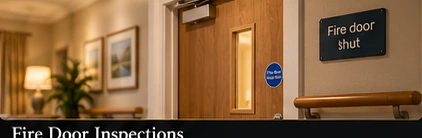
SERVICE 01
Fire door inspections
Inspecting doorsets, hardware, seals, gaps, glazing and closing performance; clear, photographed defect schedules.
Standards & approach →
Considered passive fire protection services for care homes, residential estates and commercial buildings. Meticulous inspections, intelligent reporting and a commitment to doing things properly.
Supporting FM providers, managing agents and estates teams with coordinated fire door inspections, fire damper testing, compartmentation surveys and clear, photographic reporting across England, Scotland and Wales.
From individual asset inspections to coordinated estate-wide programmes, our services help you understand your building, identify priorities and plan the right next steps.
Get a Quote →Inspecting doorsets, hardware, seals, gaps, glazing and closing performance; clear, photographed defect schedules.
Standards & approach →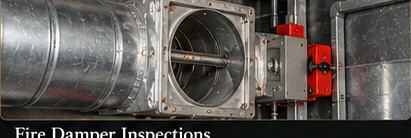
Asset-led damper inspections and operational tests, with evidence-led reporting and defect priorities.
Standards & approach →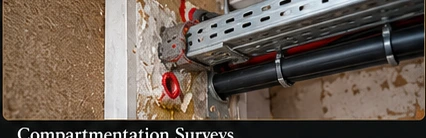
Surveys of compartment lines, penetrations and fire-stopping conditions, supported by annotated photographic evidence.
Standards & approach →Board-ready summaries, traceable asset registers, annotated images and practical action plans.
Standards & approach →Coordinated scopes, access planning, contractor interfaces and clear close-out evidence.
Standards & approach →A dependable programme of inspections, defect follow-up and organised documentation for busy estates teams.
Standards & approach →Fires attended by fire and rescue services
Fire-related fatalities
Non-fatal fire casualties
Official England figures, not UK-wide. Source: UK Government fire and rescue incident statistics. Statistics are historical and do not measure the impact of any particular inspection.
Explore the legislation, relevant guidance and practical inspection approach for each service. Expand any topic below.
The Regulatory Reform (Fire Safety) Order 2005 (as amended) requires relevant fire precautions to be maintained. For qualifying residential buildings in England over 11m, Regulation 10 requires quarterly communal-door checks and best-endeavours annual flat-entrance-door checks. These routine checks are distinct from a detailed technical inspection.
View official guidance ↗Assess the door against its evidenced specification, condition, location and the fire risk assessment; record limitations and prioritise defects. Do not assume every existing door must meet new-build standards.
Discuss this service ↗The Fire Safety Order requires relevant fire precautions to be maintained. BS 9999 provides guidance for routine fire-damper testing; applicable intervals and methods should be confirmed against the current standard, system design, manufacturer instructions and site risk.
View official guidance ↗Locate and identify each asset, check access, installation condition, support and obstruction, test operation where safely possible, and photograph results and limitations.
Discuss this service ↗The Fire Safety Order requires appropriate precautions and maintenance. Approved Document B provides statutory guidance on meeting Building Regulations in England; the applicable building design and tested system details govern remedial specification.
View official guidance ↗Trace compartment lines against available drawings, record accessible penetrations and defects, and recommend tested systems installed within their field of application. Intrusive checks require an agreed scope.
Discuss this service ↗Responsible Persons must record fire risk assessments and fire safety arrangements under the Fire Safety Order as amended. Reporting must distinguish findings, limitations, recommendations and completed remedial evidence.
View official guidance ↗Use unique asset references, dated photographs, consistent defect categories, risk-based priorities and an auditable record of follow-up.
Discuss this service ↗The Fire Safety Order places duties on Responsible Persons to maintain precautions; applicable Building Regulations, manufacturer instructions and tested specifications inform the design and execution of remedial work.
View official guidance ↗Define the scope and specification before work begins, plan around occupancy, verify competent delivery and collect installation and close-out records.
Discuss this service ↗The Fire Safety Order requires appropriate arrangements and maintenance. Specific inspection obligations vary with building type, location, equipment and risk assessment; there is no single universal interval for every asset.
View official guidance ↗Build a site-specific inspection calendar, track overdue actions, review changes in use and keep records accessible for audits and handover.
Discuss this service ↗Guidance is primarily framed for England. Requirements differ across the UK and by building type. British Standards are technical guidance, not legislation in themselves. Inspection scopes and intervals must be agreed against the applicable law, risk assessment, manufacturer instructions and current standards. Voltar does not provide a legal determination or guarantee compliance.
Care environments demand careful planning. We work around residents, visitors and operational teams, coordinating access, recording findings clearly and helping maintenance teams plan proportionate action.
From a single home to a wider portfolio, our aim is to make passive fire safety easier to understand and manage.
Talk about your estate ↗Voltar Compliance works alongside facilities management companies, managing agents and property teams to support the delivery of passive fire safety inspections across individual sites and national property portfolios.
We understand the importance of coordinated access, dependable scheduling and reporting that helps FM partners communicate clearly with their clients. Our approach is designed to complement existing maintenance and compliance programmes, including those in operational care environments.
Discuss an FM partnership →Coordinate fire door and fire damper inspections and compartmentation surveys across single or multiple sites, with minimal disruption to building operations.
Receive structured findings, photographic evidence and prioritised defect information to support client reporting and remedial planning.
Work with us on one-off surveys, scheduled inspection programmes or additional capacity during busy periods, subject to agreed scope and availability.
Support for facilities management portfolios across England, Scotland and Wales, with site-specific requirements and applicable local regulations considered.
Tell us about your building, portfolio or inspection requirements and we’ll help you plan the next step.
Monday – Friday
8:30am – 5:30pm
Closed weekends and UK bank holidays. Hours shown are assumed weekdays; confirm before launch.